

Stamp color shades often vary naturally: paper aging, ink oxidation, storage conditions, or even printing variations can all cause minor color differences. However, collectors frequently encounter „color variations” that are not actually rarities but artificially induced differences. This is why it is important to know when a color difference is natural and when you should suspect forgery.
Stamp forgery is not a new phenomenon: Hungarian law also treats the counterfeiting of stamps or the circulation of forged stamps as a separate criminal offense. Although most forgeries do not involve entire stamps but only color manipulation, the goal is the same: to deceive the collector and artificially increase the stamp's value.
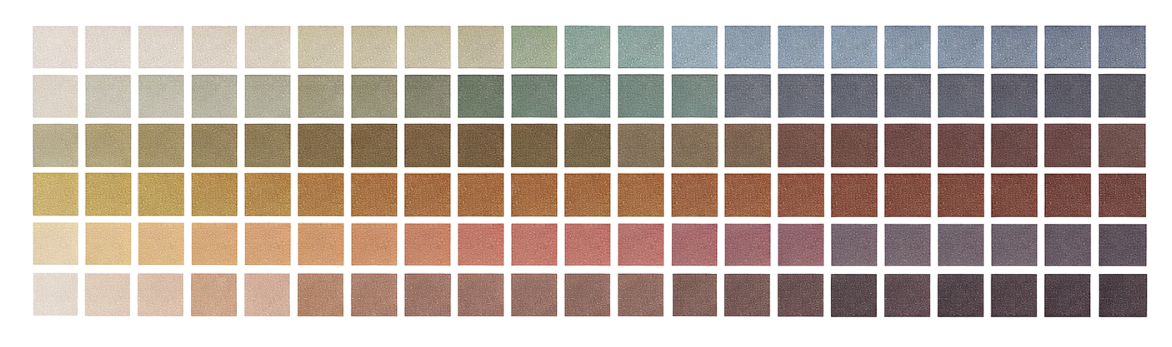 This color scale was created based on pixels extracted from Turul stamps
Natural color variation occurs when the stamp paper ages, the ink oxidizes, or the printing technology itself produces multiple shades of the same denomination. For old stamps, it is common that storage conditions – light, humidity, heat – affect the color. These differences are generally uniform, not blotchy, and do not appear „artificially vivid.”
You should suspect fake color variation if the stamp's color is conspicuously different from the usual shade, especially if the color is too bright, too contrasting, or unnatural. Chemical treatment is a common method: some substances leach out the ink, while others recolor it. In such cases, the paper structure may also be damaged, the surface may become glossier or duller, and the overall appearance of the stamp becomes „foreign.” Perforation examination can also help, as counterfeiters often neglect the integrity of the teeth or the nature of the perforation, even though perforation is one of the most important identifying features of stamps.
It is especially worth being cautious if a supposedly rarer color variation appears suspiciously cheap, or if the seller cannot provide an authentic expert opinion. For genuine rarities, an expert certificate is a basic requirement, as the stamp's value depends heavily on its authenticity. Experts – such as philatelic expertisers – can determine whether a color variation is genuine or manipulated based on the paper, ink, watermark, perforation, and printing technique.
In summary, not every different color is a rarity. Natural shade variations are part of a stamp's life, but in cases of excessive, artificial-looking color differences, we should always be cautious. Stamp examination is a technical and professional matter, in which the paper, ink, perforation, and printing characteristics all play important roles. And if it is a genuine rarity, an authentic expert opinion is indispensable.
Hozzászólások
A vélemények és tapasztalatok sokat segíthetnek másoknak is.