
Stamp Collecting in the Turul Era: The World Without Mounts and Hawid Strips
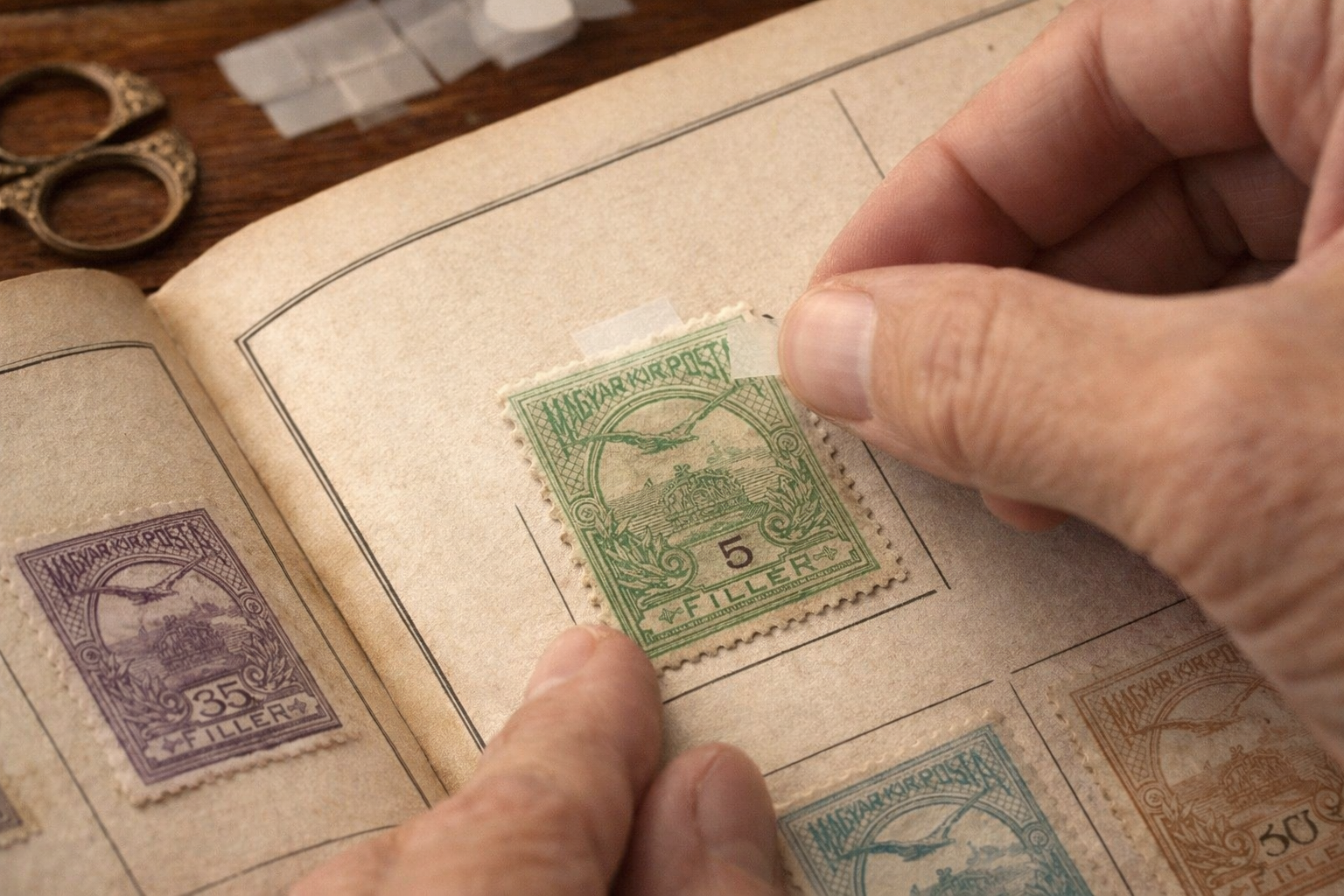
In the classic period of the Turul stamps, from the early 1900s right up to 1913, the technical conditions for stamp collecting fell far short of today's standards. In this era, the modern plastic mounts (showcases) and Hawid strips that we now consider essential did not yet exist. For collectors, the only method for attaching stamps was the so-called hinge, or stamp hinge.
The hinge was a thin, translucent strip of paper coated with gum arabic, which was licked and affixed to the back of the stamp, then stuck onto the collector album page. Since the Turul stamps were still „live” postal stamps at this time, collectors considered this mounting method natural, not anticipating that the adhesive would leave marks on the stamp's original gum.
The Foundation of Valuation: The Meaning of the Stars
Philatelic literature and catalogues (such as the Catalogue of Hungarian Postage Stamps) therefore draw sharp distinctions between stamp conditions. Since almost every mint stamp before 1913 was mounted with hinges, the valuation of period rarities is as follows:
-
* (One-star): Hinged or hinge-marked stamp. The reverse side shows traces of adhesive or remains of the hinge itself. 95% of collections from the Turul period survive in this condition.
-
** (Two-star): Mint, hinge-free stamp with original gum. In this era, this is extremely rare, as only those copies that happened to be kept in sheets or were never placed into albums remained in this state.
-
o (Circle): Used stamp. Here, the use of hinges is less critical, since the stamp has already gone through the postal process, but collectors still prefer a clean reverse side.
Today we know that due to the absence of transparent plastic mounts, the gum of Turul stamps often suffered during storage. The „hinge mark” left after removal of the hinge remains one of the most important value-modifying factors today. Anyone seeking a complete pre-1913 Turul series in completely hinge-free (**) condition must be prepared to pay several times the catalogue price for a genuine rarity.
Where Chemistry Meets Philately: Why Was There No Alternative to the Hinge?
To understand the collecting habits of the Turul era (1900–1913), we must recognise that modern packaging materials and plastics as we know them barely even existed in laboratories at the time. Collectors did not use hinges because they did not care about a stamp's condition, but because they had no neutral, transparent storage medium available.
Timeline of Cellophane and Plastics:
-
Cellophane (1908–1912): Swiss chemist Jacques E. Brandenberger patented cellophane in 1908, but industrial production and commercial distribution only began after 1912. By the time cellophane could have reached stamp collectors, the classic period of the Turul series had already ended. Moreover, early cellophane was still acidic and prone to shrinkage, causing more damage to paper than the hinge.
-
PVC and Soft Plastics (1920s–30s): The base material of today's mounts, polyvinyl chloride (PVC), only became industrially applicable in the mid-1920s (thanks to the pioneering work of Waldo Semon), but its plasticiser-free use for philately was still decades away.
-
Modern Hawid Strips (late 1940s): The adhesive-free protective strips and polystyrene-based mounts that protect the back of stamps did not appear on the market until after World War II, in the late 1940s.
Summary: When a collector placed a 12 filler Turul stamp in his album in 1905, the hinge was the cutting-edge technology available. Paper and gum arabic were natural materials, while today's chemically neutral, water-clear mounts were still in the realm of science fiction at the time. So let us regard hinge-marked specimens with respect: they are witnesses to a technical limitation that is over a hundred years old.
Commentaires
Les avis et expériences partagés peuvent être d'une grande aide pour les autres.