
The Forgotten Innovation of the Turul Era: Stamps from a Machine
In the world of Hungarian stamp collecting, there are stories that are not about rare misprints or astronomically priced auction lots, but about the technological struggles of a bygone era. Such is the brief but all the more instructive episode of „stamp coils” from the early 20th century. This story highlights that the Royal Hungarian Post had already embarked on the path of modernisation in 1912, even if the experiment ultimately did not live up to expectations.
The Decree That Started It All
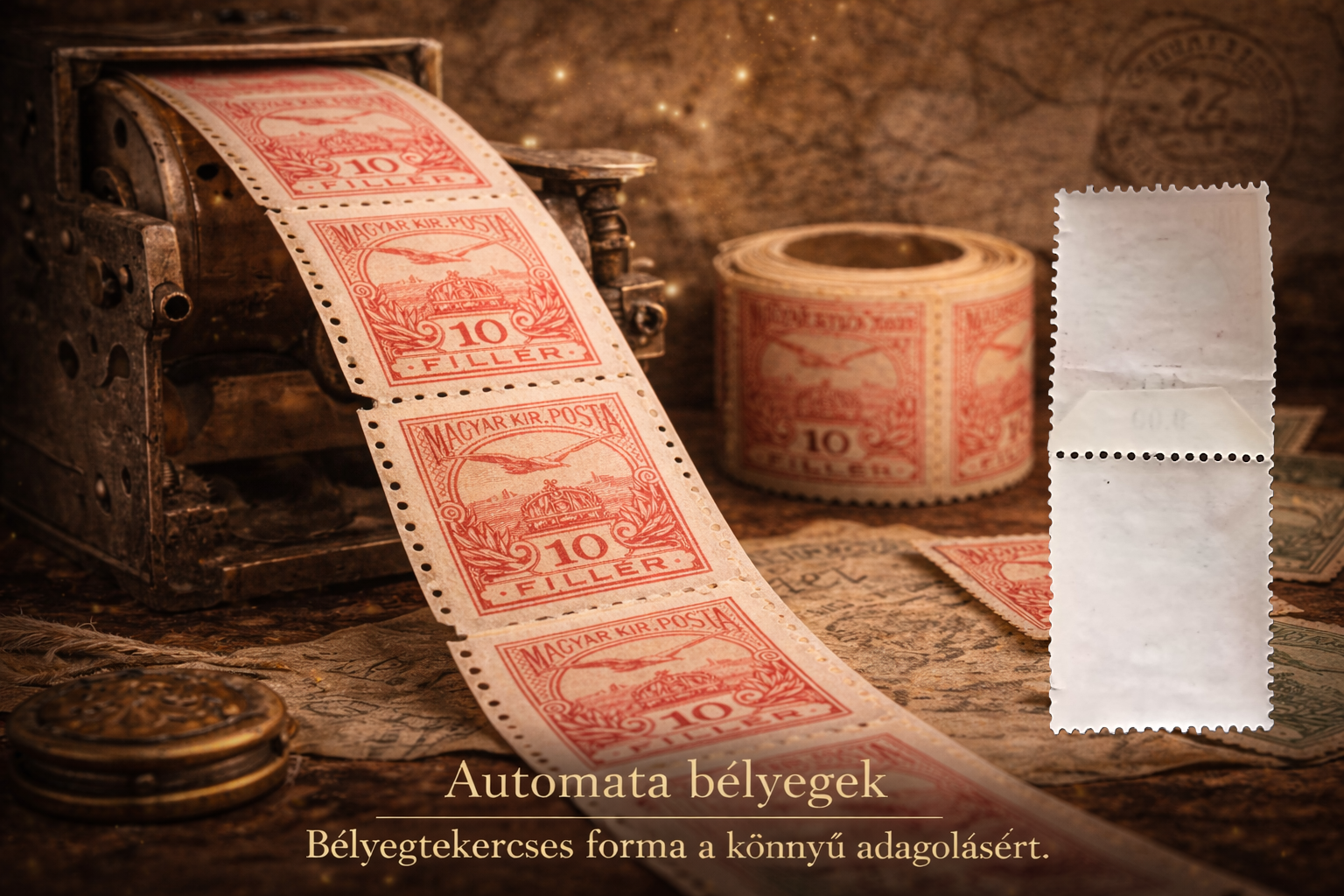
It was September 1912 when postal management yielded to market pressure. Large corporations and the businessmen of the „modern age” sought a faster solution for franking their mail. Decree No. 12.946/v. was issued, authorising the sale of 2, 3, 5, 6, and 10 filler denominations in 1000‑piece rolls.
These coils were specifically created for early franking machines. However, the regulations were extremely strict:
- Coils could not be held in stock by every office; they were only available on order.
- It was forbidden to sell them through internal postal handling or resellers.
- They were available exclusively at designated main post offices (in Budapest, for example, at Central Receiving Office No. 4).
Technological Feat: Handcrafted „High-Tech”
Although today coil stamps are printed on continuous paper strips, in 1912 the State Printing Works had to resort to a different solution. They did not produce new stamps, but manually converted already printed 100‑sheet Turul sheets.
Production steps:
- The 100‑sheets were torn into 10‑stamp vertical strips.
- The stamp at the bottom of each strip was glued manually onto the margin left at the top of the next strip.
- This was repeated until a 1000‑piece strip was assembled.
- The resulting strip was wound so that the stamp design appeared upside down when pulled out.
This is precisely why the literature aptly calls them stamp coils rather than coil stamps: because they were not a separate production technology, but merely a special packaging format.
Why Don't We See Them in Collections?
Here we arrive at the most peculiar point of the story. Although nearly 20 million pieces were placed into circulation in this form, it is almost impossible to identify them as individual specimens. Once the stamp was detached from the coil and affixed to a letter, all distinguishing marks disappeared. Since they were made from conventional sheets, neither their perforation nor their paper differed from the rest.
The End of the Experiment and the Numbers
Despite the great enthusiasm, the project was short-lived; production ceased from 1913 onwards. However, we have precise statistics on the quantities produced:
- 2 filler: 6,000 coils
- 3 filler: 540 coils (the rarest variety)
- 5 filler: 5,700 coils
- 6 filler: 6,000 coils
- 10 filler: 6,865 1000‑piece coils and 250 500‑piece coils
This episode remains for posterity as an exciting chapter from the dawn of Hungarian postal history, when manual labour sought to serve the needs of the first mechanical vending machines.
Comments
Opinions and experiences can be of great help to others as well.