History
The wine-red 50-fillér Turul: withdrawn, then sold
An oxidising ink mixture, a withdrawal in 1905 and the surprising sale of the remaining stock in 1930.…
2026.10.10.
0
Read more →
History
A Journey Through Time on Perforated Edges!
If we thought stamp collecting was merely the closed world of dusty attics and quiet afternoons of elderly gentlemen from the last century, we would be hugely mistaken. In the age of digital detox and tangible values, philately is experiencing a renaissance.…
2026.06.28.
0
Read more →
Observations
Watermark Breaks on the 1908 and 1909 Turul Issues
Damage to the crown watermark, the „ballerina” and the „chingi-lingi”. Discover the special watermark breaks of the 1908–1909 Turul stamps!…
2026.04.06.
0
Read more →
Observations
Gas Lamps and Misconceptions: The Colourful Ordeal of the 6 Filler Turul
Why did the 6 filler Turul change colour almost every year? The light of gas lamps, printing blunders, and the mystery of the „never-existed” greenish-brown stamp.…
2026.03.19.
0
Read more →
History
Why Was No New Hungarian Stamp Issued Between 1900 and 1916?
Conservative thinking, economic rationality, and wartime constraints: why did the Turul series remain in circulation for 16 years?…
2026.03.17.
0
Read more →
Observations
The Proof Prints of the Corona Values of the Turul Series and Value Number Variations
A deep dive into the printing background of the Turul series: proof prints, experimental printings without value numbers, and the system of four digit types.…
2026.03.16.
0
Read more →
History
The Peculiar Withdrawal of the 50 Filler Turul (1916–1917)
Why did the 50 filler Turul disappear a year earlier than the rest of the series? We traced the contemporary postal decrees.…
2026.03.15.
0
Read more →
History
UPU Recommendations and the Green Turuls: Why Did the 5 Filler Become Green?
Why do the 5 and 60 filler Turuls look so similar in colour? Discover the Universal Postal Union's international colour system and its impact on Hungarian stamps.…
2026.03.15.
0
Read more →
Observations
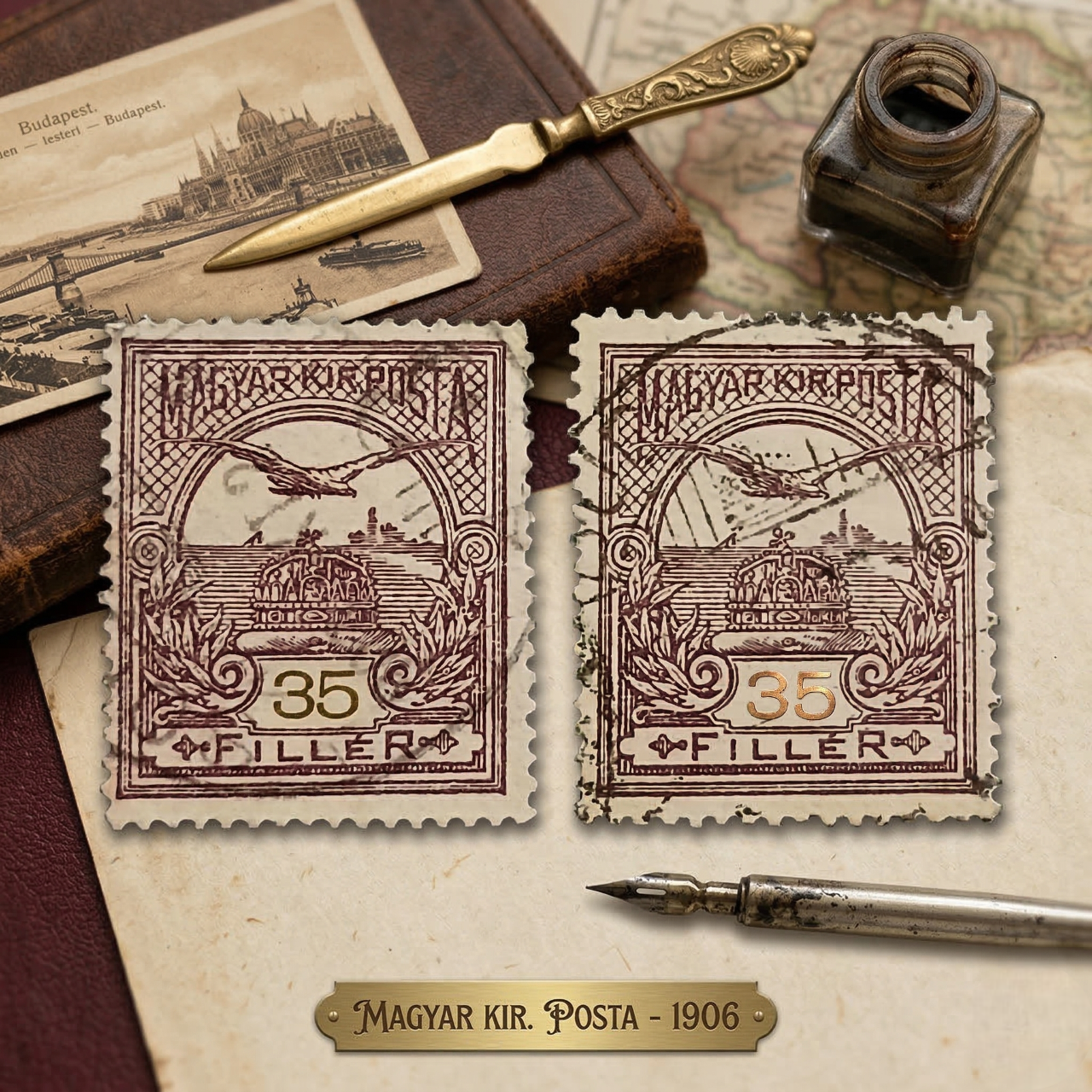
The Type Variants of the 1906 Turul 30 and 35 Filler Stamps
Learn about the types of the two-digit value inscriptions of the Turul series: the differences between Type I and Type II, and the story of the 1906 sheet rarities.…
2026.03.11.
0
Read more →
History
Distance Between Numeric Values
Type I and Type II differ in the spacing between digits. This can only be observed on two-digit numbers, i.e., the higher filler denominations.…
2026.03.11.
0
Read more →
Observations
The 2 Filler Turul: A Mini-Universe for Stamp Collectors
Why is the seemingly „ordinary” 2 filler Turul one of the most exciting collecting areas? Colour shades, plate flaws, and postal history rarities in a single denomination.…
2026.03.09.
0
Read more →
History
1908 – The Beginning of the Modern World on Hungarian Stamps
The 1908 issue of the Turul series became a symbol of Hungarian statehood, technological progress, and the modernising world, reflected through watermark changes.…
2026.03.04.
0
Read more →
History
The Fate of the Separate Post Office Operating in the Parliament Building
The parliamentary post office still operates to this day, although in a limited and non-public form. Discover the history of postal code 1358.…
2026.03.01.
0
Read more →
History
Curiosities of the Year 1905
While a young clerk at the Bern patent office, Albert Einstein published the special theory of relativity...…
2026.03.01.
0
Read more →
History
The History and Impact of the Horizontal Watermark
The discovery of the horizontal watermark in the 1913 issue caused great surprise among collectors.…
2026.02.24.
0
Read more →
Observations
The Two Cuckoo's Eggs of the 1913 Turul Series
Under collector pressure, the two filler denominations became part of the Turul series. Did you know?…
2026.02.24.
0
Read more →
History
The First Direct Marketing Campaign!
Mass-mailed letters caused a major headache for the Royal Hungarian Post.…
2026.02.24.
0
Read more →
History
The History of Stamp Coils
Stamps were converted from conventionally produced sheets to make them suitable for automatic vending machines.…
2026.02.22.
0
Read more →
Observations
The Origin and History of the Hinge (Falc)
The hinge was the only solution available to stamp collectors in the 1900s for mounting stamps in albums.…
2026.02.15.
0
Read more →
History
Budapest Post Office No. 62
The Western Main Post Office has stood in the same place since 1910 – a historical giant. It was built to meet the enormous postal demands generated at the railway station.…
2026.02.15.
0
Read more →
History
The Golden Age of the Royal Hungarian Post: When the World Looked to Budapest
The reliability of the Csonka vehicles forever wrote itself into the history of technology.…
2026.02.15.
0
Read more →
Observations
How Does Professional Stamp Authentication Work?
A range of tools and techniques are available for authenticating stamps.…
2025.12.29.
0
Read more →
Watermarks
How to Tell for Sure If Your 6 Filler Turul Is from 1900
The 6 filler Turul stamps come in several color variations, but only certain watermarks appear in the 1900 issue.…
2025.01.12.
0
Read more →
Colors
When to Suspect a Fake Color Variation?
Not every color difference is a rarity. We show you when a variation is natural and when you should be cautious.…
2025.01.05.
0
Read more →
Observations
Why Is the Watermark More Important Than the Color?
Many collectors look at the color first, but the watermark provides much more reliable clues for determining the year of issue.…
2024.12.28.
0
Read more →
Plate flaws
When Does a Plate Flaw Become Valuable?
Not every flaw adds value. We look at which flaws are sought after and which are common.…
2024.12.10.
0
Read more →


Comments
Opinions and experiences can be of great help to others as well.