Geschiedenis
De wijnrode Turul van 50 fillér: ingetrokken en later verkocht
Oxiderende drukinkt, de intrekking in 1905 en de onverwachte verkoop van de restvoorraad in 1930.…
2026.10.10.
0
Lees meer →
Geschiedenis
Tijdreis door geperforeerde randen!
Als we zouden denken dat postzegelverzamelen alleen de stoffige zolders van de vorige eeuw en de stille middagen van oude heren is, dan hebben we het grondig mis. In het tijdperk van digitale detox en tastbare waarden beleeft de filatelie een renaissance.…
2026.06.28.
0
Lees meer →
Waarnemingen
Watermerkbreuken op de Turul-uitgaven van 1908 en 1909
De beschadigingen van het kroonwatermerk, de „ballerina” en de „tsjingeli-ngeli”. Leer de bijzondere watermerkbreuken van de Turuls uit 1908-1909 kennen!…
2026.04.06.
0
Lees meer →
Waarnemingen
Gaslampen en vergissingen: De kleurrijke odyssee van de 6 fillér Turul
Waarom veranderde de 6 fillér Turul elk jaar van kleur? Het licht van de gaslampen, druktechnische blunders en het mysterie van de „nooit bestaan hebbende” groenbruine postzegel.…
2026.03.19.
0
Lees meer →
Geschiedenis
Waarom werd er geen nieuwe Hongaarse postzegel gemaakt tussen 1900 en 1916?
Conservatief denken, economische rationaliteit en de oorlogsdwang: waarom bleef de Turul-serie 16 jaar in omloop?…
2026.03.17.
0
Lees meer →
Waarnemingen
De proefdrukken van de kroonwaarden van de Turul-serie en de waardencijferafwijkingen
Een diepe duik in de druktechnische achtergrond van de Turul-serie: proefdrukken, experimentele drukken zonder waardencijfer en het systeem van de vier cijfertypen.…
2026.03.16.
0
Lees meer →
Geschiedenis
De bijzondere terugtrekking van de 50 fillér Turul (1916–1917)
Waarom verdween de 50 fillér Turul een jaar eerder dan de rest van de serie? We volgden de sporen van de hedendaagse postbesluiten.…
2026.03.15.
0
Lees meer →
Geschiedenis
UPU-aanbevelingen en de groene Turuls: Waarom werd de 5 fillér groen?
Waarom lijken de 5 en 60 fillér Turul op elkaar qua kleur? Leer het internationale kleurensysteem van de Universele Postunie (UPU) en de invloed ervan op Hongaarse postzegels kennen.…
2026.03.15.
0
Lees meer →
Waarnemingen
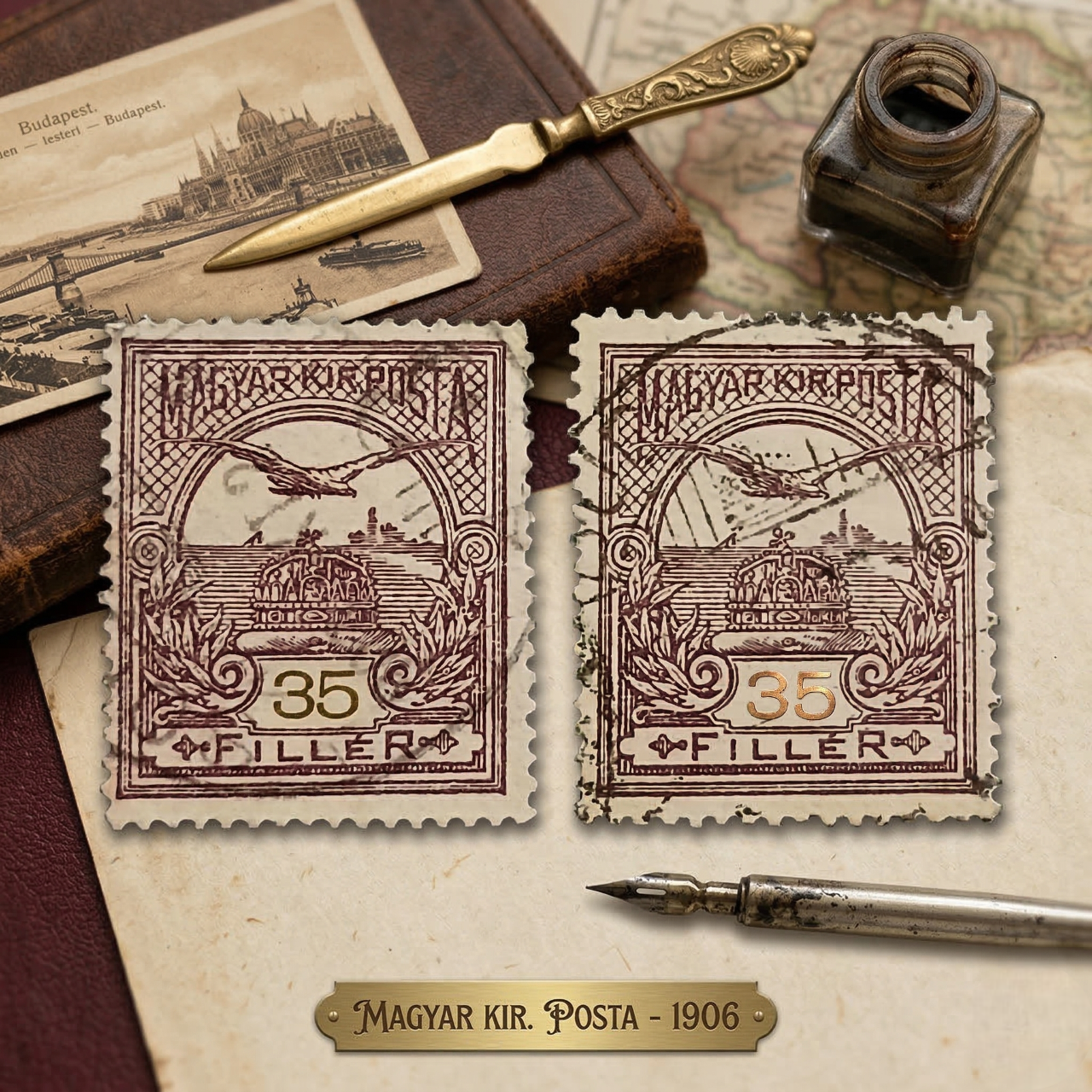
De typevarianten van de 30 en 35 fillér Turul-postzegels uit 1906
Leer de typen van de tweecijferige waarde-aanduidingen van de Turul-serie kennen: de verschillen tussen type I en II en de geschiedenis van de vel-zeldzaamheden uit 1906.…
2026.03.11.
0
Lees meer →
Waarnemingen
Afstand tussen de cijfers
Type I en II bij de cijfers. Dit is alleen waarneembaar bij de tweecijferige getallen, dus bij de hogere fillér-waarden.…
2026.03.11.
0
Lees meer →
Waarnemingen
De 2 fillér Turul: Een mini-universum voor postzegelverzamelaars
Waarom is de „gewone” 2 fillér Turul een van de meest fascinerende verzamelgebieden? Kleurschakeringen, plaatfouten en posthistorische zeldzaamheden in één enkele waarde.…
2026.03.09.
0
Lees meer →
Geschiedenis
1908 – Het begin van de moderne wereld op Hongaarse postzegels
De uitgave van de Turul-serie uit 1908 werd het symbool van de Hongaarse staatsvorming, technologische vooruitgang en de moderniserende wereld, te midden van watermerkveranderingen.…
2026.03.04.
0
Lees meer →
Geschiedenis
Het lot van het bijzondere postkantoor in het Parlementsgebouw
Het postkantoor in het parlement is tot op de dag van vandaag in bedrijf, zij het beperkt en niet openbaar. Leer de geschiedenis van de postcode 1358 kennen.…
2026.03.01.
0
Lees meer →
Geschiedenis
Bijzonderheden van het jaar 1905
Terwijl een jonge ambtenaar, Albert Einstein, in het Bernse octrooibureau de speciale relativiteitstheorie publiceerde...…
2026.03.01.
0
Lees meer →
Geschiedenis
De twee buitenbeentjes van de Turul-serie uit 1913
Op aandringen van verzamelaars werden de twee fillér-waarden onderdeel van de Turul-serie. Wist je dat?…
2026.02.24.
0
Lees meer →
Geschiedenis
De geschiedenis en impact van het liggende watermerk
De ontdekking van het liggende watermerk in 1913 veroorzaakte grote opschudding onder verzamelaars.…
2026.02.24.
0
Lees meer →
Geschiedenis
De eerste Direct Marketing zet!
De massaal verzonden brieven bezorgden de Koninklijke Hongaarse Post grote hoofdbrekens.…
2026.02.24.
0
Lees meer →
Geschiedenis
Geschiedenis van de postzegelrolletjes
De postzegels werden uit de traditionele drukvelvormen ontwikkeld om geschikt te zijn voor automatische verkoop.…
2026.02.22.
0
Lees meer →
Waarnemingen
De oorsprong en geschiedenis van de falc
De falc was de enige oplossing voor postzegelverzamelaars in 1900 om postzegels in albums te bevestigen.…
2026.02.15.
0
Lees meer →
Geschiedenis
Het postkantoor Boedapest 62
Het grote westelijke postkantoor staat sinds 1910 op dezelfde plaats en is een historische reus. Het werd gebouwd om te voorzien in de enorme postale behoeften die op het station ontstonden.…
2026.02.15.
0
Lees meer →
Geschiedenis
De gouden eeuw van de Koninklijke Hongaarse Post: Toen de wereld naar Boedapest keek
De betrouwbaarheid van de Csonka-auto's heeft zich voor altijd in de techniekgeschiedenis gegrift.…
2026.02.15.
0
Lees meer →
Geschiedenis
Hoe verloopt een professionele echtheidscontrole van postzegels?
Voor het onderzoeken van de echtheid van postzegels staan talrijke hulpmiddelen ter beschikking.…
2025.12.29.
0
Lees meer →
Watermerken
Hoe weet je zeker dat het een 6-fillér dubbeltje uit 1900 is?
Bij de 6-fillér Turul-postzegels bestaan er meerdere kleurvarianten, maar alleen met bepaalde watermerken komen ze voor in de uitgave van 1900.…
2025.01.12.
0
Lees meer →
Kleuren
Wanneer moet je een valse kleurvariant vermoeden?
Niet elke afwijkende kleur is een zeldzaamheid. We laten zien wanneer een afwijking natuurlijk is en wanneer voorzichtigheid geboden is.…
2025.01.05.
0
Lees meer →
Plaatfouten
Waarom is het watermerk belangrijker dan de kleur?
Velen kijken eerst naar de kleur, maar het watermerk biedt een veel betere houvast voor het bepalen van de jaargang.…
2024.12.28.
0
Lees meer →
Waarnemingen
Wanneer is een plaatfout waardevol?
Niet elke fout betekent een waardestijging. We bekijken welke fouten gezocht worden en welke vaak voorkomen.…
2024.12.10.
0
Lees meer →

Reacties
Meningen en ervaringen kunnen anderen veel helpen.