
In the corona values of the Hungarian Turul series, we encounter a particularly rich and diverse printing background. During the production of the stamps, several types of proof prints, experimental printings, and value number variants were created, which today represent one of the research areas of the series.
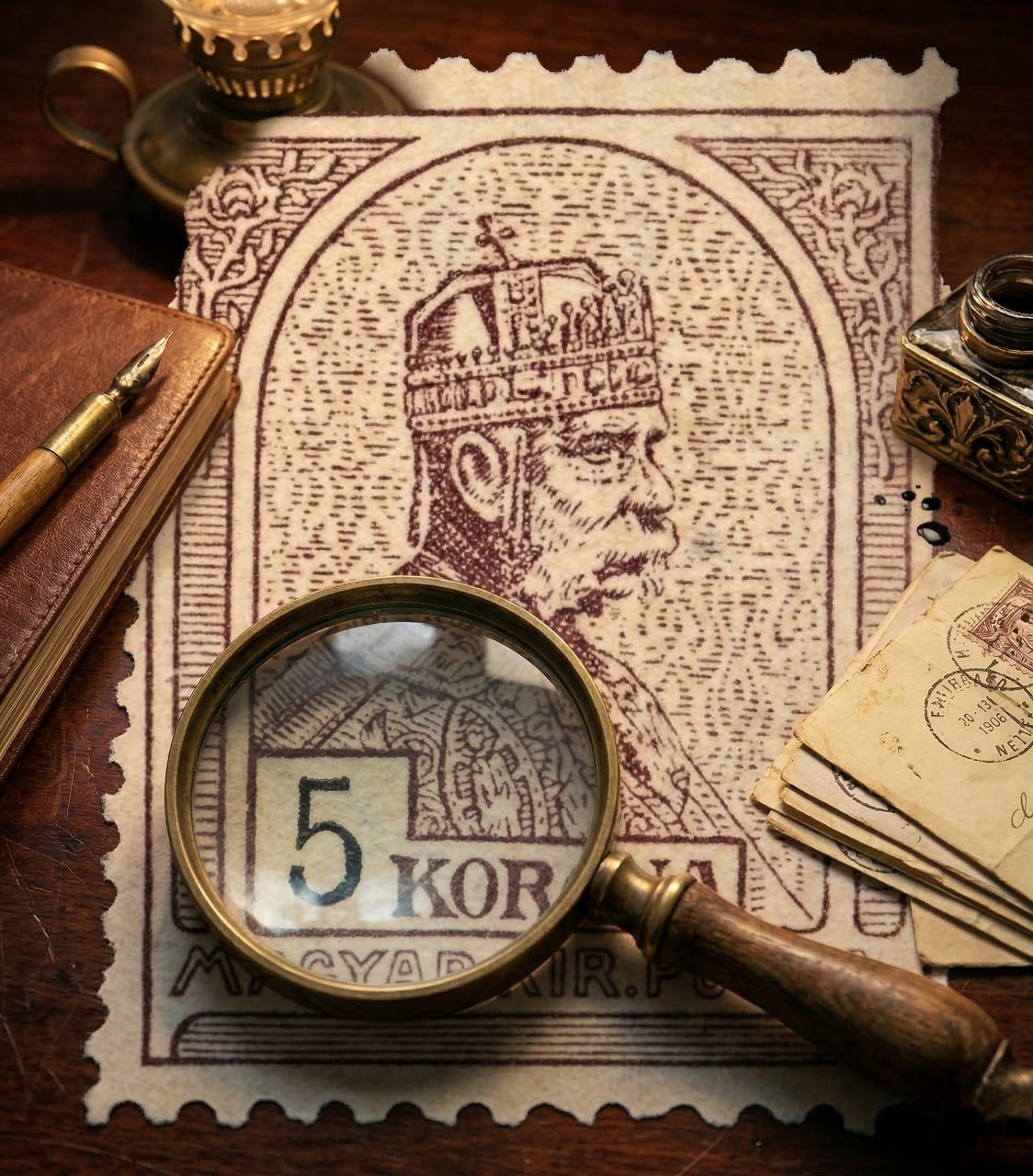
Proof Prints with the Corona Value Design
Several types of proof prints are known for the corona denominations, showing various combinations of the stamp image and value number:
- 1 corona black/black print,
- 1 corona brownish-red/black proof print (on both white and pink paper).
State Printing Works Experimental Printings
The literature divides the official state experimental materials into two main groups:
a) Value Number Without Proof Prints
These prints show the stamp image without the value number (first printing phase). Their characteristics: watermarked paper, imperforate, without gum. Known colours: grey, reddish-brown, red, and blue.
b) Proof Prints with Black Value Numbers
In these, the value number was applied using four different types of digits, proving that the value number was produced with a separate cliché:
- Type (a): sans-serif
- Type (b): sans-serif bold
- Type (c): thick sans-serif
- Type (d): small typewriter-style
Examples of occurrence:
4 filler violet: (a) and (d) | 60 filler greenish-yellow: (b) and (c) | 1 corona: (a) | 3 corona: (a)
Value Number Shifts
Since the value number was printed in a separate phase, its position can deviate significantly. The documented shifts vary in direction (right-left, up-down) and their magnitude can range from a few tenths of a millimetre to as much as 2 mm.
Since the number of variations is almost endless, collectors should focus on specimens showing the extreme values (largest shifts).
Variants of the Digit „1”
For the corona denominations, four different types of the digit „1” are known. Their use is clear evidence that the numbering was not done using a unified typeface in the printing works.
评论
意见和经验可以对其他人有很大帮助。