
The early 20th century, the period of the „happy peacetime,” was one of the brightest chapters in the history of the Royal Hungarian Post. In 1900, not only did the new century begin, but the foundations of a modern communications network that was cutting-edge even by European standards were laid. It was also at this time that the corona-filler currency system was introduced, which determined everyday payments until the dissolution of the Monarchy.
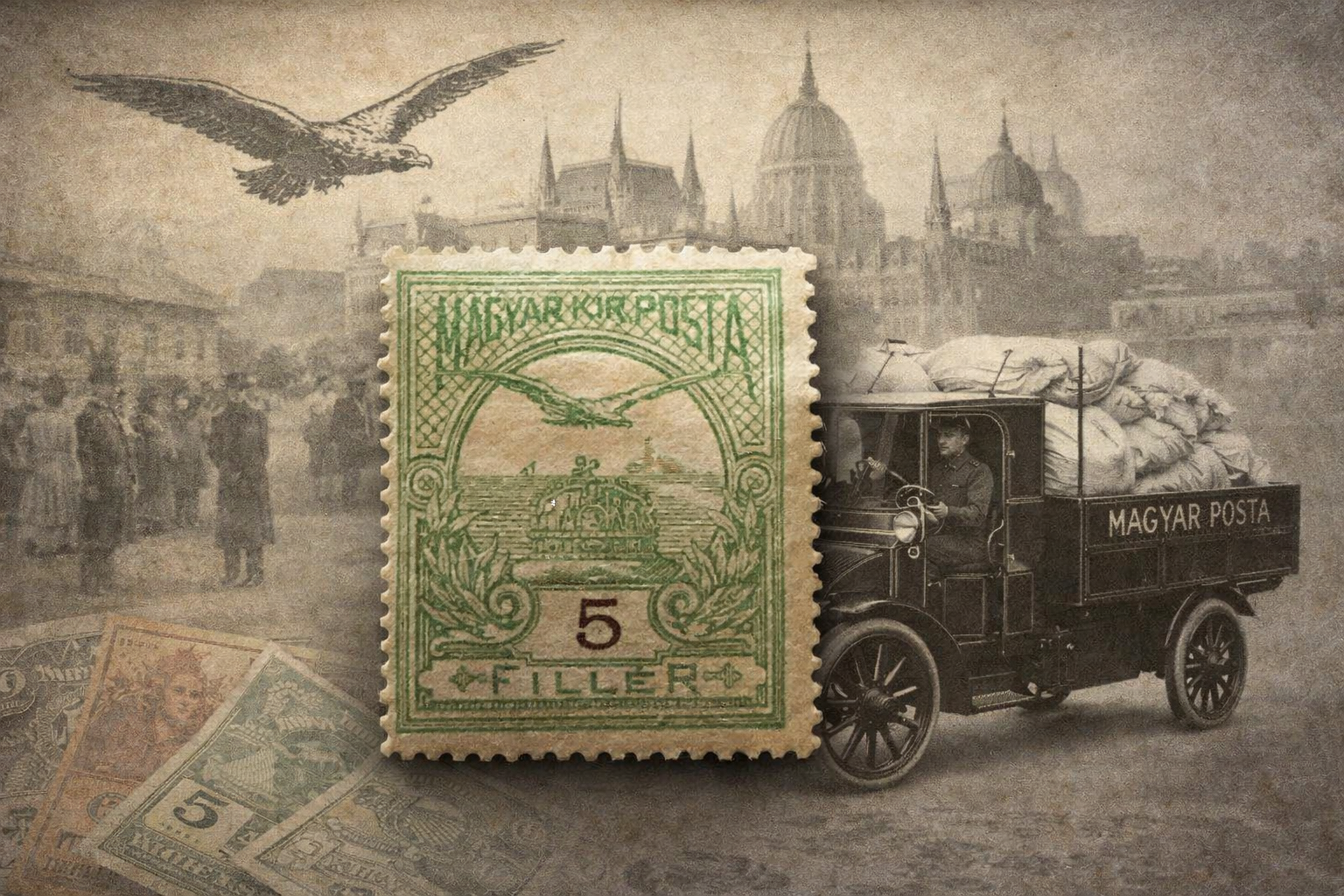
The iconic symbol of the era became the „Turul series.” The stamps that entered circulation from 1900 onwards depict the Hungarians' mythical bird, the Turul, holding the Holy Crown in its talons. At this time, sending a domestic postcard cost just 5 filler – this small green stamp made it possible for distances to suddenly become bridgeable for all segments of the population.
During this period, Hungary not only followed the world but also set the pace. On 15 June 1905, a world sensation took place in Budapest: János Csonka launched the world's first scheduled motorised postal service with his own designed vehicles. The internal combustion engine vehicles that replaced horse-drawn carriages revolutionised mail collection and parcel delivery, and Hungarian engineering genius was awarded international fame.
The montage seen in the image faithfully reflects this vibrant era: the mail coach passing in front of the majestic Parliament building, the soaring Turul, and the period banknotes all tell the story of a country that belonged to the forefront of modernisation and technological development. Although the Monarchy collapsed in 1918, the innovative spirit of the Hungarian Post and the reliability of the Csonka vehicles forever wrote themselves into the history of technology.
The History of the Hungarian Post (1848–1918)
1. The First Spark of Independence (1848–1849)
During the 1848 revolution, one of the first tasks of the Batthyány government was to create a national postal service. Under Minister Gábor Klauzál, the post came under Hungarian control.
- The goal: Issuing a Hungarian stamp (Mór Than had already designed it).
- The reality: Due to the war situation, they did not get as far as printing their own stamp, but Hungarian-language inscriptions and seals appeared at post offices.
2. The Era of Austrian Oppression (1850–1867)
After the defeat of the War of Independence, the Hungarian postal service was absorbed into the Austrian imperial machinery.
- Stamps: The first adhesive stamps appeared (1850), but these featured the Austrian coat of arms or the profile of Franz Joseph, with denominations in Austrian kreuzer.
- Language: The official language became German, and Hungarian inscriptions were removed.
3. The Compromise and the Golden Age (1867–1900)
In 1867, the Austro-Hungarian Monarchy was established. Postal affairs were one of the first areas where Hungary regained its autonomy.
- 1 May 1867: The independent Royal Hungarian Post is established.
- The first stamps: Initially, they used common (Austro-Hungarian) designs but with kreuzer denominations circulated domestically. In 1871, the first truly Hungarian-produced stamp series finally appeared (the lithographed and engraved „King's Head” series).
- Technical revolution: In 1887, Gábor Baross (the „railway minister”) unified the post and telegraph, and the network began to develop rapidly.
4. Modernisation and the „Turul” Era (1900–1914)
At the turn of the century, the post was no longer just carrying letters but had become the centre of modern communication.
- Currency change: In 1900, the kreuzer was replaced by the filler (the subunit of the Corona).
- The Turul series: The famous stamps featuring the Turul bird and royal portraits appeared, which defined the face of Hungarian correspondence until 1918.
- Innovation: Hungary launched the world's first motorised postal service (with vehicles designed by János Csonka) and the mechanisation of parcel delivery.
5. War and Collapse (1914–1918)
During the First World War, the postal service came under enormous strain.
- Field post: Millions of postcards carried news between the front and the home front (often free of charge for soldiers).
- Endgame: In 1918, with the collapse of the Monarchy, the Royal Hungarian Post also fell into crisis. In the occupied territories, Hungarian stamps were overprinted (e.g. „S.H.S.” or „Occupation francaise”), marking the end of the historical era.
Kommentare
Meinungen und Erfahrungen können auch anderen sehr helfen.