Geschichte
Der weinrote Turul zu 50 Fillér: zurückgezogen und später verkauft
Eine oxidierende Druckfarbe, der Rückruf von 1905 und der überraschende Verkauf der Restbestände 1930.…
2026.10.10.
0
Weiterlesen →
Geschichte
Eine Zeitreise auf perforierten Rändern!
Wenn wir dachten, Briefmarkensammeln sei nur die verschlossene Welt staubiger Dachböden und stiller Nachmittage älterer Herren aus dem letzten Jahrhundert, würden wir uns gewaltig irren. Im Zeitalter des digitalen Detox und der greifbaren Werte erlebt die Philatelie eine Renaissance.…
2026.06.28.
0
Weiterlesen →
Beobachtungen
Wasserzeichenbrüche bei den Turul-Ausgaben von 1908 und 1909
Beschädigungen des Kronenwasserzeichens, die „Ballerina“ und das „Chingi-lingi“. Entdecken Sie die besonderen Wasserzeichenbrüche der Turul-Marken von 1908–1909!…
2026.04.06.
0
Weiterlesen →
Beobachtungen
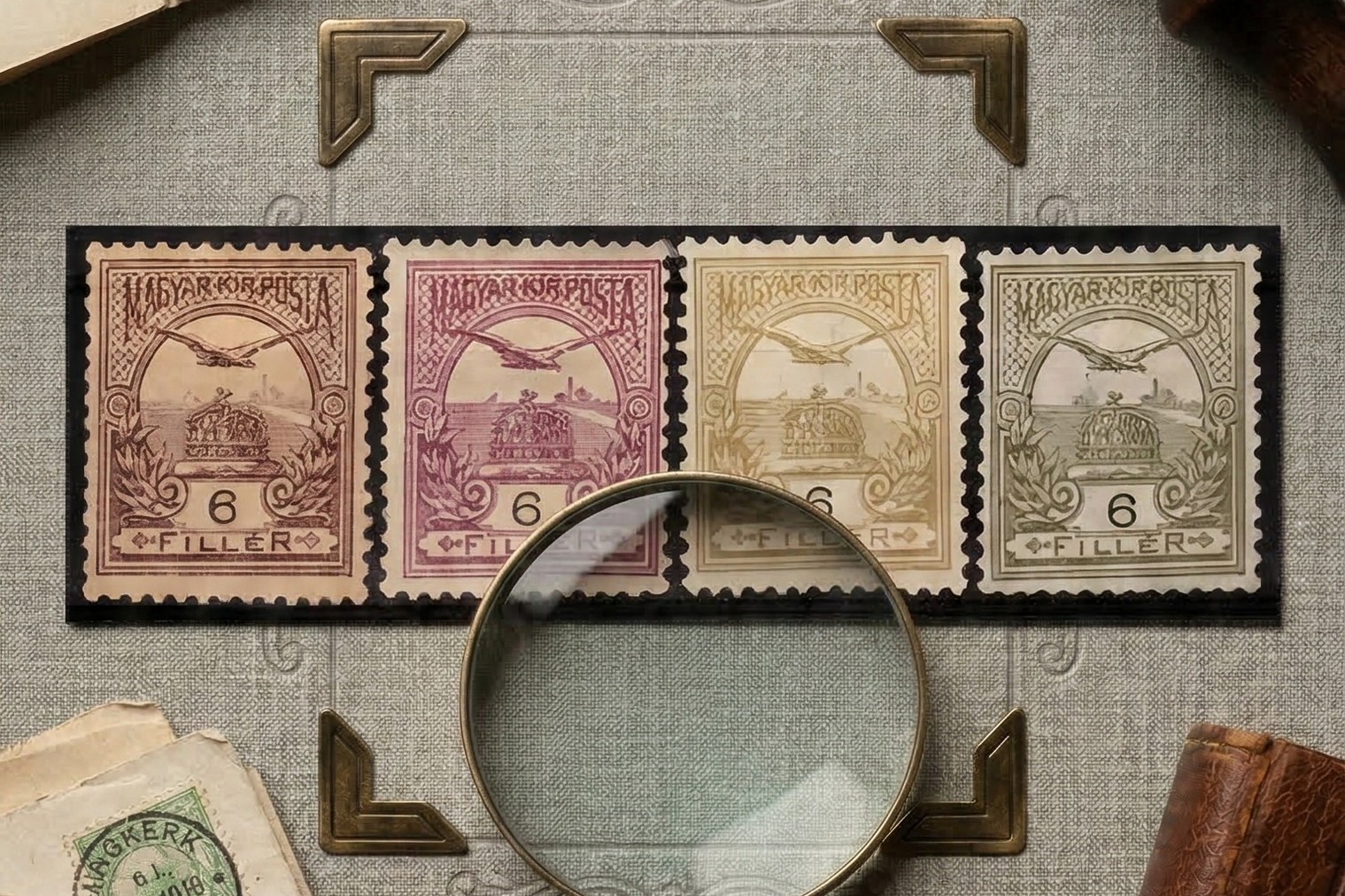
Gaslaternen und Irrtümer: Die farbenfrohe Odyssee des 6-Filler-Turul
Warum wechselte der 6-Filler-Turul fast jährlich die Farbe? Das Licht der Gaslaternen, Druckfehler und das Rätsel der „nie existierten“ grünlich-braunen Marke.…
2026.03.19.
0
Weiterlesen →
Geschichte
Warum wurde zwischen 1900 und 1916 keine neue ungarische Briefmarke herausgegeben?
Konservatives Denken, wirtschaftliche Rationalität und kriegsbedingte Zwänge: Warum blieb die Turul-Serie 16 Jahre lang im Umlauf?…
2026.03.17.
0
Weiterlesen →
Beobachtungen
Die Probedrucke der Kronenwerte der Turul-Serie und Wertzahlvarianten
Ein tiefer Einblick in den drucktechnischen Hintergrund der Turul-Serie: Probedrucke, Versuchsdrucke ohne Wertzahlen und das System der vier Zifferntypen.…
2026.03.16.
0
Weiterlesen →
Geschichte
Die eigentümliche Rückziehung des 50-Filler-Turul (1916–1917)
Warum verschwand der 50-Filler-Turul ein Jahr früher als der Rest der Serie? Wir sind den zeitgenössischen Posterlassen nachgegangen.…
2026.03.15.
0
Weiterlesen →
Geschichte
UPU-Empfehlungen und die grünen Turuls: Warum wurde der 5-Filler grün?
Warum ähneln sich der 5- und der 60-Filler-Turul in der Farbe? Entdecken Sie das internationale Farbsystem des Weltpostvereins (UPU) und seine Auswirkungen auf ungarische Briefmarken.…
2026.03.15.
0
Weiterlesen →
Beobachtungen
Die Typvarianten der 30- und 35-Filler-Turul-Marken von 1906
Erfahren Sie mehr über die Typen der zweistelligen Wertangaben der Turul-Serie: die Unterschiede zwischen Typ I und Typ II und die Geschichte der Bogenraritäten von 1906.…
2026.03.11.
0
Weiterlesen →
Geschichte
Abstand zwischen Zahlenwerten
Die Typen I und II unterscheiden sich im Abstand zwischen den Ziffern. Dies ist nur bei zweistelligen Zahlen, also den höheren Filler-Nennwerten, zu beobachten.…
2026.03.11.
0
Weiterlesen →
Beobachtungen
Der 2-Filler-Turul: Ein Mini-Universum für Briefmarkensammler
Warum ist der scheinbar „gewöhnliche“ 2-Filler-Turul eines der spannendsten Sammelgebiete? Farbnuancen, Plattenfehler und postgeschichtliche Raritäten in einem einzigen Nennwert.…
2026.03.09.
0
Weiterlesen →
Geschichte
1908 – Der Beginn der modernen Welt auf ungarischen Briefmarken
Die Ausgabe der Turul-Serie von 1908 wurde zum Symbol der ungarischen Staatlichkeit, des technologischen Fortschritts und der sich modernisierenden Welt, widergespiegelt in den Wasserzeichenänderungen.…
2026.03.04.
0
Weiterlesen →
Geschichte
Das Schicksal des separaten Postamts im Parlamentsgebäude
Das Parlamentspostamt ist bis heute in Betrieb, wenn auch in eingeschränkter und nicht öffentlicher Form. Entdecken Sie die Geschichte der Postleitzahl 1358.…
2026.03.01.
0
Weiterlesen →
Geschichte
Kuriositäten des Jahres 1905
Während ein junger Angestellter im Berner Patentamt, Albert Einstein, die spezielle Relativitätstheorie veröffentlichte...…
2026.03.01.
0
Weiterlesen →
Geschichte
Die Geschichte und Auswirkung des liegenden Wasserzeichens
Die Entdeckung des liegenden Wasserzeichens in der Ausgabe von 1913 löste bei den Sammlern große Überraschung aus.…
2026.02.24.
0
Weiterlesen →
Beobachtungen
Die zwei Kuckuckseier der Turul-Serie von 1913
Unter dem Druck der Sammler wurden die zwei Filler-Nennwerte Teil der Turul-Serie. Wussten Sie das?…
2026.02.24.
0
Weiterlesen →
Geschichte
Die erste Direct-Marketing-Kampagne!
Massenhaft versendete Briefe bereiteten der Königlich Ungarischen Post große Kopfschmerzen.…
2026.02.24.
0
Weiterlesen →
Geschichte
Die Geschichte der Markenrollen
Marken wurden aus konventionell hergestellten Bögen umgewandelt, um sie für Automaten geeignet zu machen.…
2026.02.22.
0
Weiterlesen →
Beobachtungen
Der Ursprung und die Geschichte des Falzes
Der Falz war die einzige Lösung für Briefmarkensammler in den 1900er Jahren, um Marken in Alben zu befestigen.…
2026.02.15.
0
Weiterlesen →
Geschichte
Das Postamt Budapest 62
Das große Westbahnhof-Postamt steht seit 1910 am selben Ort – ein historischer Gigant. Es wurde gebaut, um den enormen Postbedarf am Bahnhof zu decken.…
2026.02.15.
0
Weiterlesen →
Geschichte
Das goldene Zeitalter der Königlich Ungarischen Post: Als die Welt nach Budapest blickte
Die Zuverlässigkeit der Csonka-Fahrzeuge schrieb sich für immer in die Technikgeschichte ein.…
2026.02.15.
0
Weiterlesen →
Beobachtungen
Wie läuft eine professionelle Echtheitsprüfung von Briefmarken ab?
Für die Echtheitsprüfung von Briefmarken stehen zahlreiche Hilfsmittel zur Verfügung.…
2025.12.29.
0
Weiterlesen →
Wasserzeichen
Wie erkennt man sicher, dass ein 6-Filler-Turul von 1900 ist?
Bei den 6-Filler-Turul-Marken gibt es mehrere Farbvarianten, aber nur bestimmte Wasserzeichen kommen in der Ausgabe von 1900 vor.…
2025.01.12.
0
Weiterlesen →
Farben
Wann sollte man eine gefälschte Farbvariante vermuten?
Nicht jede abweichende Farbe ist eine Rarität. Wir zeigen, wann eine Abweichung natürlich ist und wann Vorsicht geboten ist.…
2025.01.05.
0
Weiterlesen →
Beobachtungen
Warum ist das Wasserzeichen wichtiger als die Farbe?
Viele schauen zuerst auf die Farbe, doch das Wasserzeichen bietet viel zuverlässigere Anhaltspunkte für die Bestimmung des Jahrgangs.…
2024.12.28.
0
Weiterlesen →
Plattenfehler
Wann ist ein Plattenfehler wertvoll?
Nicht jeder Fehler bedeutet eine Wertsteigerung. Wir zeigen, welche Fehler begehrt sind und welche häufig vorkommen.…
2024.12.10.
0
Weiterlesen →


Kommentare
Meinungen und Erfahrungen können auch anderen sehr helfen.