
1905: The Year of Relativity and the Turul
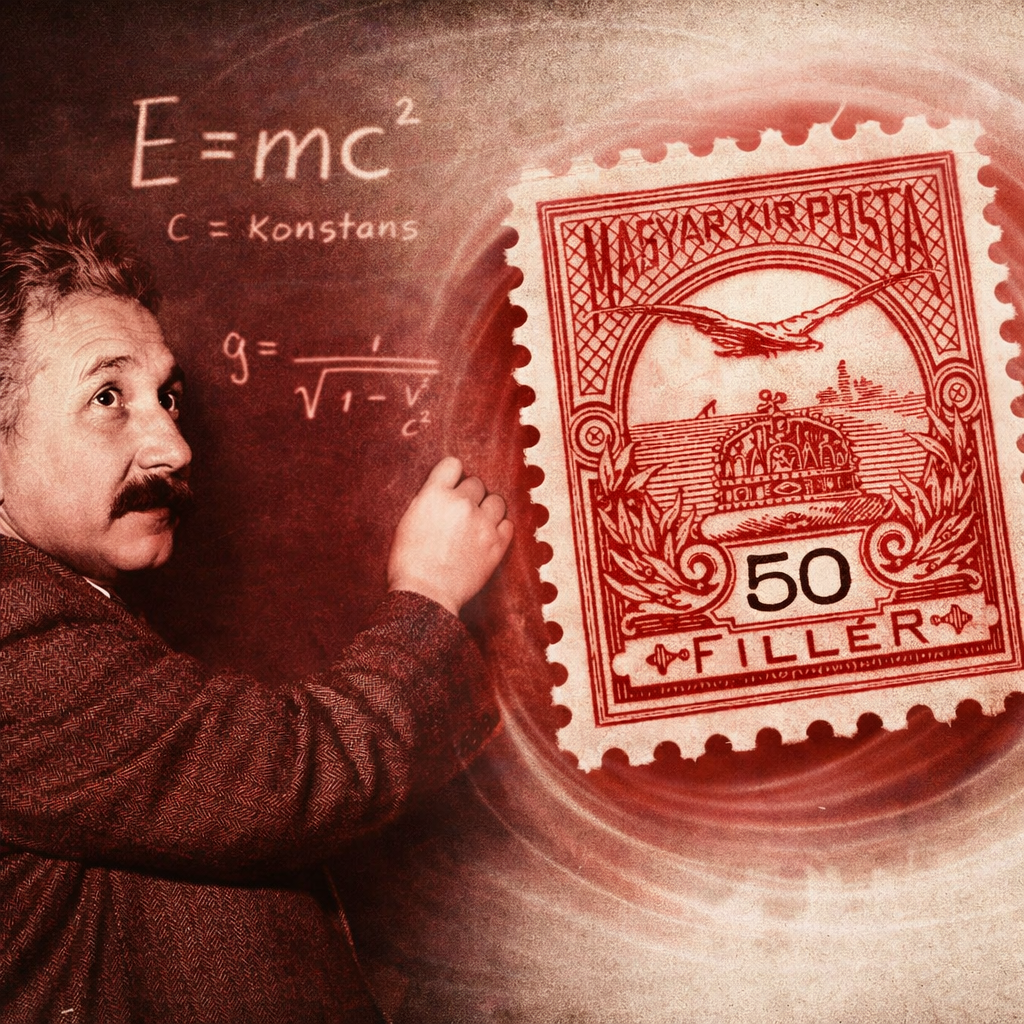
1905 is referred to by the history of science as the annus mirabilis, the „year of wonders,” but it was at least as momentous for Hungarian philately. While a young clerk at the Bern patent office, Albert Einstein published the special theory of relativity, fundamentally overturning our understanding of time and space, at the Budapest State Printing Works it was tangible quality and precision that took centre stage.
The Meeting of Technology and Materials
Hungarian stamp production at this time was transitioning into the modern era. Responding to the needs of collectors and the post, the State Printing Works put a new 15‑tooth comb perforating machine into operation on 2 November 1905, which gave the Turul series a much finer and more regular appearance.
At the same time, the so-called „y” paper variety appeared: this thicker, soft and flexible white paper became the carrier of the nation's symbol, lending durability and elegance to everyday correspondence.
Philatelic Sensations and the Spirit of the Age
The year started with a discovery: in January 1905, observant collectors came across the special wine-red 50 filler Turul stamp, which has since become one of the period's favourite colour varieties.
While in philately it was changes in watermarks (which also affected the postage due stamps that year) and the precision of perforations that occupied public attention, culture and science were exploding on other planes:
The revolution in physics: Einstein's equations (E=mc²) demonstrated the equivalence of mass and energy.
A literary birth: In this year, Attila József was born, who would later himself sing of the social and human tensions of the era.
What Connects Them?
Perhaps a shared desire for precision. Just as Einstein sought connections in the minutiae of the universe, so too do lovers of philately find the historical imprint of the era among the teeth of the 15‑tooth perforation and in the fibres of white paper.
评论
意见和经验可以对其他人有很大帮助。